Friday, 17 August 2012

Storing Solar Thermal Energy

News from phys.org/:
""Storing Solar Thermal Energy in Chemical Form has the Potential to Make it Indefinitely Storable and Transportable.

David L. Chandler, MIT News Office

A molecule of fulvalene diruthenium, seen in diagram, changes its configuration when it absorbs heat, and later releases heat when it snaps back to its original shape.

Broadly speaking, there have been two approaches to capturing the sun’s energy: photovoltaics, which turn the sunlight into electricity, or solar-thermal systems, which concentrate the sun’s heat and use it to boil water to turn a turbine, or use the heat directly for hot water or home heating. But there is another approach whose potential was seen decades ago, but which was sidelined because nobody found a way to harness it in a practical and economical way.
This is the thermo-chemical approach, in which solar energy is captured in the configuration of certain molecules which can then release the energy on demand to produce usable heat. And unlike conventional solar-thermal systems, which require very effective insulation and even then gradually let the heat leak away, the heat-storing chemicals can remain stable for years.
Researchers explored this type of solar thermal fuel in the 1970s, but there were big challenges: Nobody could find a chemical that could reliably and reversibly switch between two states, absorbing sunlight to go into one state and then releasing heat when it reverted to the first state. Such a compound was discovered in 1996, but it included ruthenium, a rare and expensive element, so it was impractical for widespread energy storage. Moreover, no one understood how the compound worked, which hindered efforts to find a cheaper variant.
Now researchers at MIT have overcome that obstacle, with a combination of theoretical and experimental work that has revealed exactly how the molecule, called fulvalene diruthenium, accomplishes its energy storage and release. And this understanding, they said, should make it possible to find similar chemicals based on more abundant, less expensive materials than ruthenium.
Essentially, the molecule undergoes a structural transformation when it absorbs sunlight, putting the molecule into a higher-energy state where it can remain stable indefinitely. Then, triggered by a small addition of heat or a catalyst, it snaps back to its original shape, releasing heat in the process. But the team found that the process is a bit more complicated than that.
“It turns out there’s an intermediate step that plays a major role,” said Jeffrey Grossman, the Carl Richard Soderberg Associate Professor of Power Engineering in the Department of Materials Science and Engineering. In this intermediate step, the molecule forms a semistable configuration partway between the two previously known states. “That was unexpected,” he said. The two-step process helps explain why the molecule is so stable, why the process is easily reversible and also why substituting other elements for ruthenium has not worked so far..
In effect, explained Grossman, this makes it possible to produce a “rechargeable heat battery” that can repeatedly store and release heat gathered from sunlight or other sources. In principle, Grossman said, a fuel made from fulvalene diruthenium, when its stored heat is released, “can get as hot as 200 degrees C, plenty hot enough to heat your home, or even to run an engine to produce electricity.”
Compared to other approaches to solar energy, he said, “it takes many of the advantages of solar-thermal energy, but stores the heat in the form of a fuel. It’s reversible, and it’s stable over a long term. You can use it where you want, on demand. You could put the fuel in the sun, charge it up, then use the heat, and place the same fuel back in the sun to recharge.”
In addition to Grossman, the work was carried out by Yosuke Kanai of Lawrence Livermore National Laboratory, Varadharajan Srinivasan of MIT’s Department of Materials Science and Engineering, and Steven Meier and Peter Vollhardt of the University of California, Berkeley. Their report on the work, which was funded in part by the National Science Foundation and by an MIT Energy Initiative seed grant, was published on Oct. 20 in the journal Angewandte Chemie.
The problem of ruthenium’s rarity and cost still remains as “a dealbreaker,” Grossman said, but now that the fundamental mechanism of how the molecule works is understood, it should be easier to find other materials that exhibit the same behavior. This molecule “is the wrong material, but it shows it can be done,” he said.
Jeffrey Grossman explains how this material can be used to store and release energy in the form of heat.
Video: Jeffrey C. Grossman; additional editing: Melanie Gonick
The next step, he said, is to use a combination of simulation, chemical intuition, and databases of tens of millions of known molecules to look for other candidates that have structural similarities and might exhibit the same behavior. “It’s my firm belief that as we understand what makes this material tick, we’ll find that there will be other materials” that will work the same way, Grossman said.
Roman Boulatov, assistant professor of chemistry at the University of Illinois at Urbana-Champaign, said of this research that “its greatest accomplishment is to overcome significant challenges in quantum-chemical modeling of the reaction,” thus enabling the design of new types of molecules that could be used for energy storage. But he adds that other challenges remain: “Two other critical questions would have to be solved by other means, however. One, how easy is it to synthesize the best candidates? Second, what is a possible catalyst to trigger the release of the stored energy?”
Grossman plans to collaborate with Daniel Nocera, the Henry Dreyfus Professor of Energy and Professor of Chemistry, to tackle such questions, applying the principles learned from this analysis in order to design new, inexpensive materials that exhibit this same reversible process. The tight coupling between computational materials design and experimental synthesis and validation, he said, should further accelerate the discovery of promising new candidate solar thermal fuels.""

Thursday, 16 August 2012

Thermochromic glass (IV)

I would like to finish the article at the address http://www.hindawi.com/journals/jnm/2012/491051/ 
""The morphology of the undoped and W-doped VO2 nanopowders is characterized by SEM as shown in Figure 1. It is observed in Figures 1(a) to 1(g) that the tungsten dopant concentration almost has no effect on the morphology of the nanoparticles, and the particle sizes are about 20–60 nm. The experimental results also indicate that particles will be congregated with the increase of annealing time. Especially, the particles with 2 at% W-doped are relatively uniform, and the size is about 25 nm, which is in favor of the practice application on thermochromic window coatings. As is known, small and uniform particles are relatively easy to disperse in solvent and obtain homogeneous coating. [..]
TEM images of the undoped VO2 and 2 at % W-doped VO2 nanopowders are shown in Figures 4(a) and 4(c). The morphologies and sizes of the as-obtained samples are consistent with those of SEM images in Figures 1(a) and 1(e). Figures 4(b) and 4(d) show the lattice-resolved HRTEM images.[..] ""
 -) What is the difference between TEM, SEM and HRTEM?
Here is the answer difference-between-tem-and-sem/
or here on Wikipedia: High-resolution_transmission_electron_microscopy 
""When the phase transition of VO2 occurs, it exhibits a noticeable endothermal or exothermal profile in the DSC curve. Figure 5(a) shows the typical DSC curves of undoped and 2 at% W-doped VO2 nanopowders. With 2 at% W-doped sample, Mott phase transition arises at around 44°C and 34.5°C for the heating and cooling cycles, compared to 71°C and 58°C for the undoped VO2, respectively. The phase transition can be modified under the different factors such as defect density or lattice change . The appearance of endothermal and exothermal peaks during the heating and cooling process confirms the first-order transition between monoclinic VO2 (M) and tetragonal rutile VO2 (R) . To be vital for the practical thermochromic effect applications, the phase transition temperature of W-doped must be approaching to room temperature. In this case, the phase transition temperature could be reduced to 35°C with 3 at% W-doped in Figure 5(b).""

For the full discussion please see the cited article.

Lihua Chen, Chunming Huang, Gang Xu, et al., “Synthesis of Thermochromic W-Doped VO2 (M/R) Nanopowders by a Simple Solution-Based Process,” Journal of Nanomaterials, vol. 2012, Article ID 491051, 8 pages, 2012. doi:10.1155/2012/491051

Friday, 27 July 2012

Comfort (I)

I would like to continue with the environmental comfort discussion, trying to answer the following question:

-) Which indices should be studied for the environmental comfort?

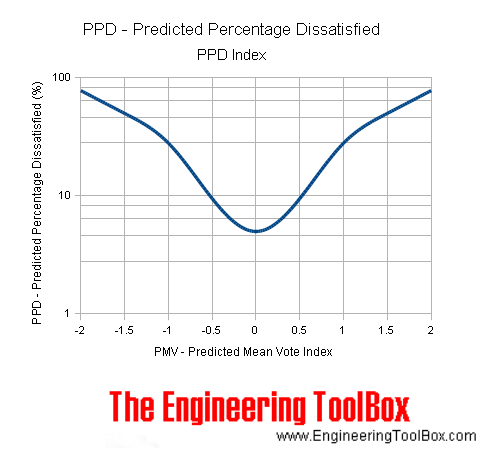
There are two index called PMV (Predicted Mean Vote) and PPD (Planned Percentage of Dissatisfied). Let us try to understand them.
From materials by E. Moretti , we can read:

     "" The PMV (Predicted Mean Vote) is a mathematical function that depends on: clothing, air temperature, activity, mean radiant temperature, air velocity, humidity.
     

It represents the average grade given by a large sample of people residing in the same environment, expressing their thermal sensation through a psychophysical scale that ranges from a value of +3 (very hot) to -3 (very cold) through intermediate situations in which the 0 corresponds to neutrality.
     The PMV is related experimentally to PPD (Planned Percentage of Dissatisfied) (%), a parameter that expresses the number of people who would be dissatisfied of climatic conditions.
     PPD = 100 - 95exp [- (0.03353 + 0.2179 PMV4 PMV2)] ""
I finish this post bringing the graph of relationship between PDD and VMP. From barcol-air.nl read:
""There is a fixed relation Between the PMV and PPD value. When the PMV value is Between the recommended -0.5 + 0.5 and the PPD will be lower than 10%. The percentage dissatisfied in this model will never be lower than 5%.""

Tuesday, 24 July 2012

Thermochromic glass (III)

I'm always afraid to publish the material I found on the net, especially if it's in articles.
I found at the site http://www.hindawi.com that, in his articles it writes:
    ""Copyright © 2012 This is an open access article distributed under the Creative Commons Attribution License, which permits unrestricted use, distribution, and reproduction in any medium, provided the original work is properly cited.

You are free:
to Share — to copy, distribute and transmit the work
to Remix — to adapt the work
to make commercial use of the work

Under the following conditions: Attribution — You must attribute the work in the manner specified by the author or licensor (but not in any way that suggests that they endorse you or your use of the work. ""
So I think I'm free to report some articles.
If someone know more about this License, please contact me.
Well, today I talk about the vanadium doping with tungsten (finally)!
To do this, I use the article http://www.hindawi.com/journals/jnm/2012/491051 [I].
Repeating the first concept already expressed before, as the basis of thermochromism:
""[..] At temperatures ranging from −147°C to 68°C VO2 materials show the fully reversible phase transition between monoclinic VO2 (M) and tetragonal rutile phase VO2 (R) fascinatingly around 68°C. [..]

Furthermore, the phase transition temperature can be adjusted to near room temperature by doping, which is realized by the incorporation of metal ions into the VO2 lattice. Tungsten, molybdenum, chromium, titanium, fluorine, and niobium, and so forth are frequently used for this purpose because they produce relatively larger TC shifts with less dopant concentrations. [..]

TC is the transition temperature.

    ""So far, as an intelligent window material, the study of W-doped VO2 mainly focused on thin films and nanoparticles. It has been prepared by a variety of methods involving excimer-laser-assisted metal organic deposition (ELAMOD) , magnetron sputtering , chemical vapor deposition (CVD) , pulsed laser deposition (PLD) , and vacuum evaporation . However, all of these methods are not suitable for putting into practice because of complex control parameters, unstable technology, and the necessity of special and expensive equipment . Chemical solution deposition seems to be an alternative solution to the above problems due to its low cost and the option of metal doping. But this method usually requires specific raw materials or pretreatments which limit their practical applications . [..] In this paper, we report a simple solution-based process to prepare pure VO2 and W-doped VO2 nanopowders with cheap and nontoxic vanadium (V) precursors and short reaction times. ""

Here it is introduced ELAMOD.
-) What is the process?On http://staff.aist.go.jp/t-nakajima/research-e.html we read:

    ""The ELAMOD is the process which applies the laser energy instead of high temperature. At first, metal-organic solution is spin-coated onto a substrate, and then the film is pre-heated to decompose organic components, if needed. Finally, the film is directly irradiated by excimer laser. This method is very useful for low-temperature fabrication. [..] So this process is enable to fabricate thin films onto the substrate which are weak against high temperature such as Si and glass. Moreover, the patterning can be also easily realized since the film is crystallized at only laser irradiated region. Thus, the ELAMOD process is quite prospective for its application potentials.""


[I] : Lihua Chen, Chunming Huang, Gang Xu, et al., “Synthesis of Thermochromic W-Doped VO2 (M/R) Nanopowders by a Simple Solution-Based Process,” Journal of Nanomaterials, vol. 2012, Article ID 491051, 8 pages, 2012. doi:10.1155/2012/491051

Friday, 20 July 2012

Thermochromic glass (II)

As we have seen, thermochromic coatings have two problems:
-) High critical temperature,
-) Limited visible transmittance. Today we write about this.
Through experimental observations, Babulanam and Granqvist noted as an anti-reflection coating of SiO2 contribute to increase the light transmittance of the glass.
In details, it is compared: the luminous transmittance between a device with only a glassy layer of 200 nm of VO2 and one with VO2 in turn covered with a film of SiO2, having various thicknesses.
The results show that, with a thickness of 100 nm of SiO2, the luminous transmittance at a wavelength of 650 nm increases from 42% to about 55% at 20 °C, justifying what has been said.
Many compositions have been analyzed to create such a protective film, including those based on SnO2, In2O3 or CeO2. I want to cite the use of  TiO2 as important because of its possible applications in DSSC (dye-sensitized solar cells) called Grätzel cells (photoelectrochemical cells) which will be discussed shortly.

Wednesday, 11 July 2012

Photochromic glass


Today I write about photochromic glasses . In simple terms, the photochromism is a mechanism where the device darkens with the sun, and then returns to the initial state if the exposure vanishes. At the transparent state is characterized by a transmission in the visible of about 80-90%, which decreases progressively during the change up to 10-15%. [1]
In more technical terms, the photochromic materials have the ability to reversibly change their absorption characteristics in response to the wavelengths of radiation (especially ultraviolet light). This phenomenon is obtained using iron oxide with fluorides (or chlorides) of silver or copper.

An animation of the process is here.

The phenomenon was observed as early as 1960 by using a Corning silica glass doped with silver, but the difficulty in producing large areas and his "uncontrollability" has allowed the use of this phenomenon only to visual lenses, in devices for cars .
An interesting case is the anti-glare rearview mirror that some manufacturers offers, since it's an example of a user controllable photochromic device (UCPC defined = user controlled photo-Chromic). [2] It's able to change the color even if the radiation is low, or almost completely absent (as we have seen, the glass isn't transparent to UV) with a very good response times. In reality, a UCPC is very similar to a glass of electrochromic type, which will be analyzed in another post.

Here is an example graph of transmittance (I don't have real experimental data).

Red line = clear glass
Blue line = tinted glass 

The complete discussion with the data is in [2].

[1] www.corning.com

[2] Gimtong Teowee, Todd Gudgel, Kevin McCarthy, Anoop Agrawal, Pierre Allemand, John Cronin, "User controllable photochromic (UCPC) devices", Electrochimica Acta 44, (1999), 3017-3026.

Saturday, 7 July 2012

Innovative prototype

As you can read in the history of PPG [1], the idea of coupling multiple panes spaced a few millimeters existed already in the 40s, initially using air in the chamber. Then the use of inert gases such as argon, Krypton (but only in the most important) has been implemented as well as creating a vacuum between the panes (optimal solution but hardly used).
There are innovative devices, one of them from BEET/project_page:
The system consists of a reversible window frame holding two glazing components: a transparent glazing that provides a weatherproof seal, and an absorptive glazing having top and bottom vent openings for airflow. While the airflow may be natural or mechanically-driven, the window frame can be rotated so that the absorptive glazing is either on the interior (for space heating in winter) or on the exterior (for reducing unwanted-heat in summer).
Taken from [2]
The development test was conducted in Hong Kong, where best solution is "summer mode", with a reduction of heat transfer equal to about 70%.

Taken from [2]

Since the heat extraction capability of flowing water is much better than flowing air, there is a version with water into the chamber.
In addition to reducing the transmission of the incoming heat in the building, this has other advantages, including the possibility of obtaining a pre-heating of the water. For this reason its possible use in a pool that has large windows, for example, fascinates me.

You can read the full discussion on [3]. It requires knowledge of fluid mechanics to analyze the motions of the water flow, but it's a very interesting article, also because of the tests and comparisons using different glass types in the assembly.

[1] http://www.ppg.com/en/Pages/home.aspx
[2]: BEETRU
[3] Chow Tin-Tai, Li Chunying, Lin Zhang. Innovative solar windows for cooling demand climate. Solar Energy Materials and Solar Cells, 94(2), 2010, 212-220.

Tuesday, 12 June 2012

low-e and trasmittance

In this post I write about the low-e glass mentioned in the post glass kind. About this topic there is a very interesting article on greenbuildingadvisor.com:
""[..] During the 1980s, glazing manufacturers perfected spectrally selective coatings that made it possible to produce low-solar-gain insulated glazing. During the 1990s, as builders in hot climates learned how these coatings reduced cooling loads, low-solar-gain glazing took an increasing share of the U.S. market.

Most builders prefer to order just one type of glazing. Window manufacturers share the same interest, since they prefer to promote a limited number of glazing options. As a result, low-e insulated glazing with a low SHGC is fast becoming the industry norm, from the Canadian border to the Gulf of Mexico.""
As it is already known, the effects of this coating is to decrease the factor U of the glass, and therefore the transfer of heat.

They can be applied in two modes: one is called in line -CVD- and takes place during the creation of the device. The result is called hard coat: it is very durable and can be positioned externally in contact with the weather (though almost never happens). The second way of coating is done in a separate phase of the production of the glass (off-line)-MSVD-. The result, said soft coat, is much more vulnerable than the previous, and it can deteriorate even in contact with air. So this is usually placed between two glass panes. This method is much more flexible, and gives the possibility to obtain more products aiming at ​​the ideal glas.

Problem: the SHGC. Knowing that a window has a layer of low-e tells us nothing about the solar factor, because it is a different matter than the factor U (low-e layer acts with longer wavelengths). For this, we have an other factor called "Light to Solar Gain" (LSG), obtained from the relationship between light transmittance and solar factor. An higher value means that the glass lets through the visible but not infrared. If this value is at least 1.25 the device is called "spectrally selective glass" [1].
Question: It is always better than a low solar factor? Or in other words, it's always better a soft coat or an hard? The answer is "no, not always." A selective glass is ideally best, but everything depends on climate. From the article we read:
 ""A window can have low-and low SHGC and represent a good opportunity for a home in Florida, or a high SHGC and work for a home in Minnesota.""

 From the article, however we understand how the thing isn't acknowledged by some manufacturers or sales agents.

Now we see transmittance graphs of some low-e glasses produced by the same company.
Low-e with hard coat


Low-e with soft coat

Low-e selective with soft coat

Comparison

blu line =  Low-e with hard coat
red line = Low-e with soft coat
yellow line = selective Low-e


With soft coat the transmittance is almost exclusively within the range of the visible.

Wednesday, 6 June 2012

Great news!

Today I post a message on personal pages of R. Binions:
http://webspace.qmul.ac.uk/rbinions/

"" 19/04/2012 Marking season is well and truly Underway and i have been going through no fewer than 14 project reports! A serious activity. Aside form that i sono stati writing papers and blackberries yet to have submitted a couple. Hopefully I'll know here, my good news soon about Them. Some of my work on thermochromic glazing has-been recieving some attention on blogs - in particolare Marco Berti's "Building The Chameleon" - Have a look at the English site here. '"
This will mean that I have to upgrade more often the site http://chameleonbuilding.blogspot.it/!

Thanks for your job, Russel !!

Tuesday, 17 April 2012

Thermochromic glass (I)

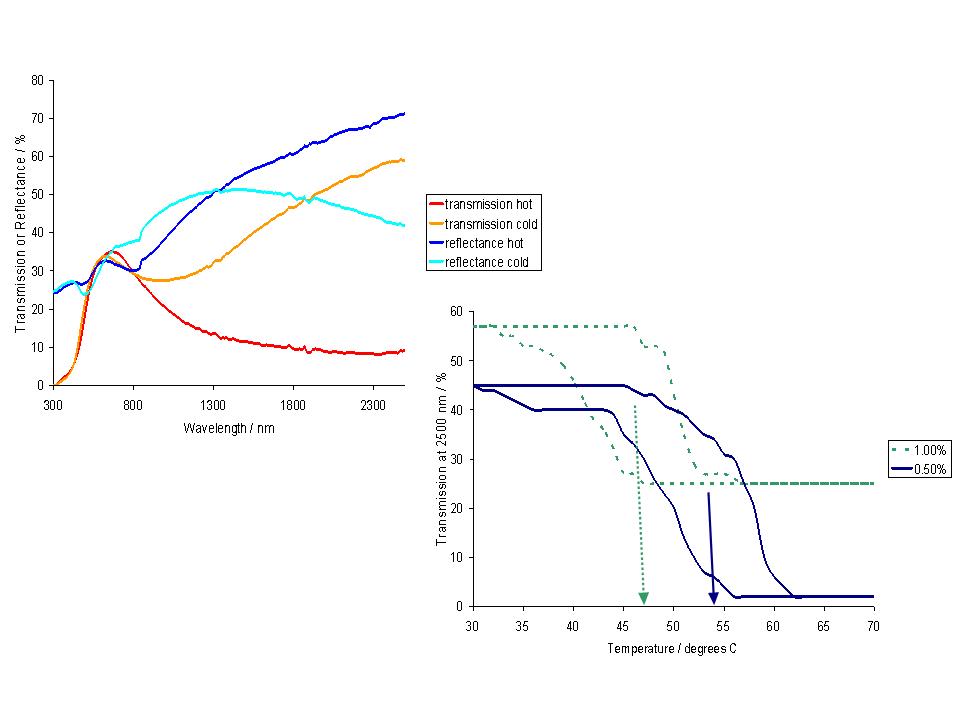
-) How to vary transmittance and reflectance of a thermochromic glass coated by vanadium dioxide?

To answer this question I use material from Russell Binions's site, who gaves me permission to use it days ago.
On the left we see the trends of the transmittance and reflectance at different temperatures:
-) Yellow pattern: transmission BELOW the critical temperature;
-) Red pattern: transmission ABOVE the critical temperature;
-) Light blue pattern: reflection BELOW the critical temperature;
-) Blue pattern: reflection ABOVE the critical temperature.

Note how in an autonomous way the transmittance is reduced strongly in the infrared range, while the reflectance on the contrary increases.
Now we can understand the fundamental effect of TC glass on energy savings.
 In addition we have said in a previous post :
""VO2 has a reddish color and it exhibits a transition from semiconductor to metal at the critical temperature Tc = 68 ° C with a change of its crystal structure. The value of the transition temperature isn't fixed, being able to change  by using dopants (such as molybdenum or tungsten), depending on the environmental temperature that  has to  respond. ""
Today we see graphically what has been said.
In the second half of the previous picture we can see a hysteresis behavior in response to the variation of temperature at a wavelength λ = 2500 nm, between the heating and cooling of the glass.  The critical temperature Tc is defined as the center of that cycle.
By doping the film with tungsten we see as the temperature drops considerably.

But these issues will be considered and analyzed in the future.

Tuesday, 27 March 2012

hard coat vs soft coat

Today i will talk again about low-e layers.

Where put we this films?

As we already said, it depends on the type: hard or soft.
As first we will define the surfaces which we will refer to.
The part of the double glass windows toward the outside is called Surface #1 and #2 #3 #4 follow, with #4 as the one facing the inside of the building.
Obviously if it is triple glass we have #5 and #6

We begin defining invernal condition:

Using as coating:  
Cardinal LoE 366 : low-e soft coat 4.8 mm
Pilkington Energy AdvantageTM : low-e hard coat 4.7 mm
then:
Pilkington Optifloat Clear : clear glass 4.7 mm
Internal chamber 12 mm with a mix of Air (10%) and Argon (90%)

Analizing U in invernal regime the singles surfaces temperatures are:


We notice that with the external hard coat we have not substantial improvements but we obtain a lower value of U with an internal coating, and so with the temperature.


The soft coat do not influence U and the temperatures, which are definitively higher than the other cases. But soft coat will influence the tripler glass behaviour.

Hybrid solution with soft and hard coats:


From this data we conclude that the hybrid solution soft#2 / hard#4 seems to be the more interesting, and so the Dual Low-E of Pilkington has been developed. But even this has some weaknesses.
Which ones in the next post.

Tuesday, 20 March 2012

Thermochromic glass

We return to the thermochromic glazing:
-)How they work?

Surely the most important principle is the use of vanadium, a mineral discovered by the mineralogist Andres Manuel del Rio in Mexico City in 1801, and having China, Finland, South Africa and the United States as largest producers.

His dioxide, VO2, has a reddish color and is a material that exhibits a transition from semiconductor to metal at the critical temperature Tc = 68°C, with a change in its crystal structure.
In fact the value of the transition temperature is not fixed and we are able to change it with the use of dopants (such as molybdenum or tungsten) depending on the required application and the environmental temperature to which will respond to. From the moment Granqvist proposed the film of VO2 like innovative coating for "smart windows", there have been many experiments to analyze the various aspects associated with it, using the different methods of deposition such as sputtering, CVD, sol-gel. Results have been achieved and analyzed for the various different aspects.

Monday, 5 March 2012

Smart window della Samsung

Strolling  around the net, looking for fresh news on "smart windows" for energy saving, i found this post with a video, and i found it curious:
""Trust Samsung to come up with an innovation that completely shocks the world, and yet manages to stay green. Unveiled at CES 2012, the Samsung Smart Window could be the next to-die-for addition to your home. Essentially a large transparent touch screen that doubles up as a full-fledged window, this is the type you wouldn’t want people throwing rocks at to grab your attention when your parents are asleep and your phone line’s dead. Enabling you to check you social network accounts, watch movies, book flight tickets, keep up with   presentations and a lot more, this fabulously intelligent window uses solar energy to charge up, keeping your energy footprint minimal. A brilliant innovation that the world is bound to welcome home.""

Here is called smart a touchscreen working as a windows. I found this invention interesting but i hope they wont use this concept as "smart windows". Luckily i found a polemic article that criticize this definition:
""[..] The device is really a transparent touch screen LCD that can be fitted to any window, so long as it’s no longer than some 46 inches. Resolution is 1366 x 768 pixels, reportedly. During the day, illumination is provided from outside. At night, built-in lights kick in. [..] Samsung has indicated an intention to put the thing out by the end of the year. No word on price yet. Aren’t there privacy concerns, as windows become devices for browsing, tweeting, and watching TV? Samsung assures that your neighbors won’t be able to see what you’re doing; the glass works like a one-way mirror when viewed from the outside. Here’s the main problem with Samsung’s “smart window” concept, though: touch screens, as Steve Jobs said, “don’t want to be vertical”—holding your arm out to fiddle with them just plain doesn’t feel nice, as I addressed in a post earlier in the week. Does that mean the only suitable market for a Samsung smart window is a glass-bottom boat? ""

Friday, 2 March 2012

Inverter for photovoltaic panels

What are inverters for photovoltaic panels? 
To answer at this question, I use a part of the site http://www.bcp-energia.it/:

    
"" The
inverter is an electronic device for converting direct current generated by solar cells into alternating one. It's connected to the electricity grid to power the main uses of your home. Since the control unit is powered by the photovoltaic modules, the inverter is switched off completely during the night, and so it doesn't consume energy.

    
These devices extend basic possibilities of
generic inverters with other, more advanced, through the use of particular control system to extract maximum power from solar panels. This function is called MPPT, an acronym for Maximum Power Point Tracker.

    
The photovoltaic modules in fact, have a characteristic curve V / I; there's an optimum working point said maximum power point, where it's possible to extract all the available power. This point of the characteristic
curve varies continuously as a function of solar radiation striking the cell surface. It's evident that with an inverter "freezed" at this point,we can always have the maximum power available in any condition. ""

 
For example :


"" There are several techniques for creating the MPPT function, with differences in dynamic performance and accuracy. Although the MPPT accuracy is extremely important, the settling time is, in some cases, even more. While all inverter manufacturers are able to obtain accurate on MPPT (typically between 99 to 99.6% of the maximum available), only few are able to combine speed with accuracy.

   On days with variable cloudiness we have the greatest change of solar power.
It's very common to detect variations of 100W / m² to 1000-1200W /
in less than 2 seconds. Under these conditions, which are very frequent, an inverter with settling times less than 5 seconds can produce up to 15% -20% of energy more than a slower one. [..] ""
To finish the post, I report the news of a product read some days ago:

""[..] Siemens Industry Inc. further strengthens its portfolio of solar inverters with the introduction of its new Sinvert PVM UL inverter, designed for peak efficiency and maximum plant yields to convert solar energy into grid-compliant AC voltage for infeed into conventional power supply networks. The Sinvert PVM UL inverters are available in the range from 12kW to 24kW for small to medium sized plants in the commercial market, and are capable of delivering over 98% peak efficiency. [..] ""
http://www.bcp-energia.it/ :
http://www.onlinetes.com/renewable-solar-energy-Siemens-022912.aspx

Tuesday, 17 January 2012

Glass properties.

The solar energy that isn't directly transmitted by glass can be partly reflected and partly absorbed. The ratio of each of these components on the incident flux, respectively define the dimensionless factors of reflection (reflectance, ρ), absorption (absorbance, α) and transmission (transmittance, τ) of the glass itself, linked by the equation α + ρ + τ = 1.
The total trasmitted solar radiation normalized by the incoming irradiance is called in Solar Heat Gain Coefficient, SHGC.
It should be noted that absorbance give an amount of heat radiated from the glass.
http://www.pilkington.com


 The used nomenclature is reported here:
 The governing equation for the energy flow per surface area units at the center of glass is given by :


Saturday, 14 January 2012

Current situation windows.

We have already mentioned the problem with frames and their heat loss, especially if they are made of glass parts. Over the years we had a great evolution in this areaand now we have many products on the market whit different types of material, profile and so on. Especially the introduction of dual-chamber (thus having triple glazing) made possible the improving of thermal performance. This has also been imposed by the Italian Law Decree 311/2006, which imposed limits on the value of U transmittance (parameter that determines the heat transfer of a body) depending on the italian climate zone.


Zona climaticaValore di U [W/m2]
A3.7
B2.7
C2.1
D1.9
E1.7
F1.3


 Image www.linfissosas.it


Why do we have to introduce innovative technologies?

The answer lies in the behavior of the glass against the wavelengths of radiation. Solar energy can be transmitted into a room, and consequently absorbed by the objects and the walls. They emit a thermal radiation with a wavelength greater than 5 microns (then in the far infrared) where the glass is virtually opaque, and so the transmission is blocked. So the solar power provided tends to worsen the ambient quality (the greenhouse effect is accented in the summer) and requires the use of air conditioning to balance.


The perfect glass will be the on that allow light radiation transmittance and blocks infrared radiation, especially when the temperature rises. The problem isn't evident for traditional residential buildings in cold or mild climates, but manifest itself in recent buildings with large windows, or subjects in warmer climates.

Hence the idea of testing chromogenic glazing, including my favorite glasses: thermotropic and thermochromic ones.

 www.linfissosas.it
 www.saint-gobain-glass.com

Friday, 13 January 2012

Power of the Sun.

After these necessary preambles, I must write about the sun, because it represents the starting point for the new technologies development.

Leaving aside technical description of our star as the diameter and composition, to analyze the properties of solar energy we should consider the radiation emissions, and for this reason we define the spectral irradiance Is {[W/(m2 · μm)] o [W/(m2 · nm)]}. It's the power incident on the surface area per unit time per wavelength. Integrating we get the uniform irradiance G {[W/m2]}.

We know that the Earth's orbit is slightly elliptical with an average distance equal to 149.5 x 10⁹. The average irradiance outside the atmosphere on a plane perpendicular to rays is 1367 W/m2, and it's called solar constant Gcs. This value was proposed for the first time by Samuel Pierpont Langley and then it was refined between 1322 W/m2 and 1412 W/m2 , depending on the terrestrial latitudes.

Through the atmosphere, the solar radiation decreases; it is partly absorbed, partly reflected and partly diffused. This energy loss is defined by the atmosphere thickness that sun's rays have to travers measured at sea level, and it's known as Air Mass, AM. At mediterranean latitudes it is 1.5, with a value of irradiance G about 963 W/m2.

A model called ASTM G173-03
was created to represent the spectrum solar irradiance on a surface in the one and only one set of standard conditions and orientation. [1]
More detailed information can be found at:
ASTM G173-03 AM 1.5

 
Here reported it's a plot from the same site.


Solar radiation dies at 2500 nm, and consists in three parts: UV up to 380 nm (it carries only a few percent of the incoming energy), the visible between 380 nm and 780 nm (about 50% of the incident solar energy), infrared over 780 nm (close to 50%).

[1]: http://rredc.nrel.gov/solar/spectra/am1.5/

Thursday, 12 January 2012

Moist air thermodynamic

Enviromental comfort is one of the most important objectives in buildings, threatened by thermal bridges, defined as the preferential way for the heat loss. There are many blogs that already talk about it, so it isn't an issue I would discuss. However I think it's better to spend few words for the topic in the title, because it's very important in any decision planning .

There are two different types of thermal bridges, geometric and structural ones. The geometric one doesn't depend on the type of material or isolation, but only on the geometry (for example the room corners). The structural bridge depends on the presence of different materials in the structural elements  (for example a concrete pillar in a brick wall). In both cases, however, there is an area at a lower temperature. The problem is not just a matter of energy loss, but also increase the possibility of condensation that can generate an unhealthy mold.

How can form the surface condensation?

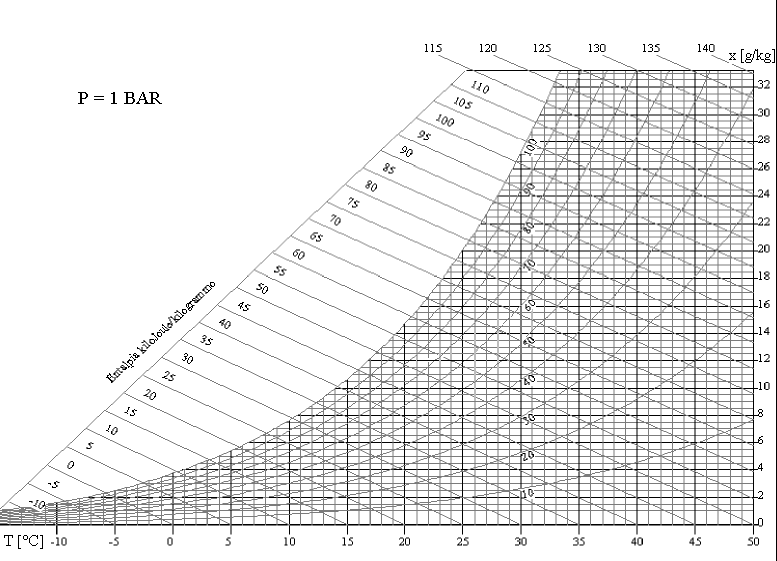
We must mention some elements of moist air thermodynamic. First of all the air may contain an amount of water vapor, and this quantity depends on both temperature and pressure (therefore it has two variables).

At constant pressure, if the air temperature increases also increases the maximum amount of water content ("saturation"). In those conditions if the humidity goes up, there is condensation (or fog). For condensation we have a temperature called "dew point", derived using a diagram knowing the air temperature and relative humidity (Mollier diagram).
Normally the air is not saturated and we consider relative humidity (Rh), expressed as a percentage compared to saturation humidity. This depends on human activities and on the amount of water vapor that the building is able to evacuate by walls or windows.
We have an analogous case with the constant temperature; the pressure of water vapor contents is called "partial pressure" (Pv), and the maximum is called "saturation pressure" (Ps), whose values are tabulated. Their ratio (Pv / Ps)  expresses the percentage relative humidity

Wednesday, 11 January 2012

Problem analysis

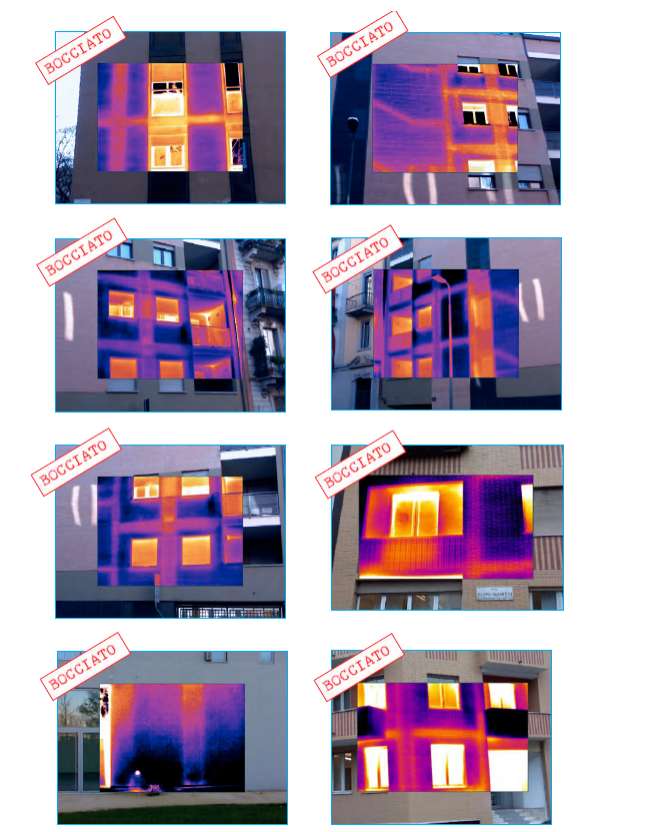
To prove claims in the previous post, I report a document done by Legambiente, which monitors 100 buildings (public and private) in 15 Italian cities. As announced in the foreword [1], the aim "was to show the advantages of a well-built building." I don't want to write about the controversy related to energy certification, given sometimes too easily, almost like a formal document. A talk about this topic is not my purpose.
What I wish to emphasize is that out of the 100 buildings, all defined A class, 89 didn't pass the verification and the remaining 11 are all built in Bolzano, making it the best city among those analyzed. This is an evident basic problem, and consequently talking about new technologies to reduce energy requirements seems a bit inopportune. But the example of Bolzano keep hope alive.
The full report is at:

The analysis was performed using thermography, a technique to "photograph" the heat emissions of a given surface. There's a very interesting blog on this matter at  http://latermografia.blogspot.com/ , where you can find the post "Come è fatta una termocamera" to understand the instrument.

The problems were: walls without insulation, low-quality or bad assembled windows, thermal bridges between different materials and so on. The thermal bridges are issues to be eliminated, both for the heat lost,and for health reasons.

Let's see some report images of a recent building (2009), that shows the horizontal and vertical structures, colored yellow or red. We distinguish perfectly the shape of pillars and floors.

Monday, 9 January 2012

Vision of the problem

First of all it's good to start with a general overview on the problems related to energy needs, a share of witch is imputable to air conditioning. This is partially due to the habits of users who changed their perception of comfort, bearing less and less hot or cold rooms, or due to the increasingly urbanized and warm cities and the differents ways of building.

The graph below [1], shows the fraction of energy used between 1973 and 2003 in residential and commercial buildings. Comparing the use of different types of primary energy resource, you can see how the use of electricity increased gradually.
Certainly the diffusion of household appliances (such as dishwashers, TVs and personal computers) has an important role, but the growth of electric power usage is also due to air conditioners and in some parts of the world is still increasing. This triggered the problem, because very often we want environments that from thermal point of view are like a "sieves". On this topic, long time ago, the architect Giancarlo Allen, secretary of the National Association for bioecological architecture, wrote [2]:

"The buildings in recent decades have been the most inefficient one can imagine from the energetic point of view. It can be useful to mention here some of the most important examples of this inefficiency:

- the wild use of always lighter and "flimsy" walls caused unexpected problems of thermal bridges with loss of heat;

- The tendency to increase glass surfaces in buildings created as a symbol of modern architecture, until they turned into a sort of element of a new urban monumentality;

- The total disregard for proper exposure of the buildings to the sun led to consider less relevant the opportunity to use natural light in places to live and work. "

Sources:
1: Hirst N., Dixon R., Unander F., Gielen D., Taylor M., Cazzola P. , Malyshev T., Janssen R.. a cura di Sullivan S. e Sanford S., “Scenarios & Strategies: 2006 to 2050”, IEA/OECD, Parigi, Francia, (2007), Capitolo 6.

2: www.crsoft.it