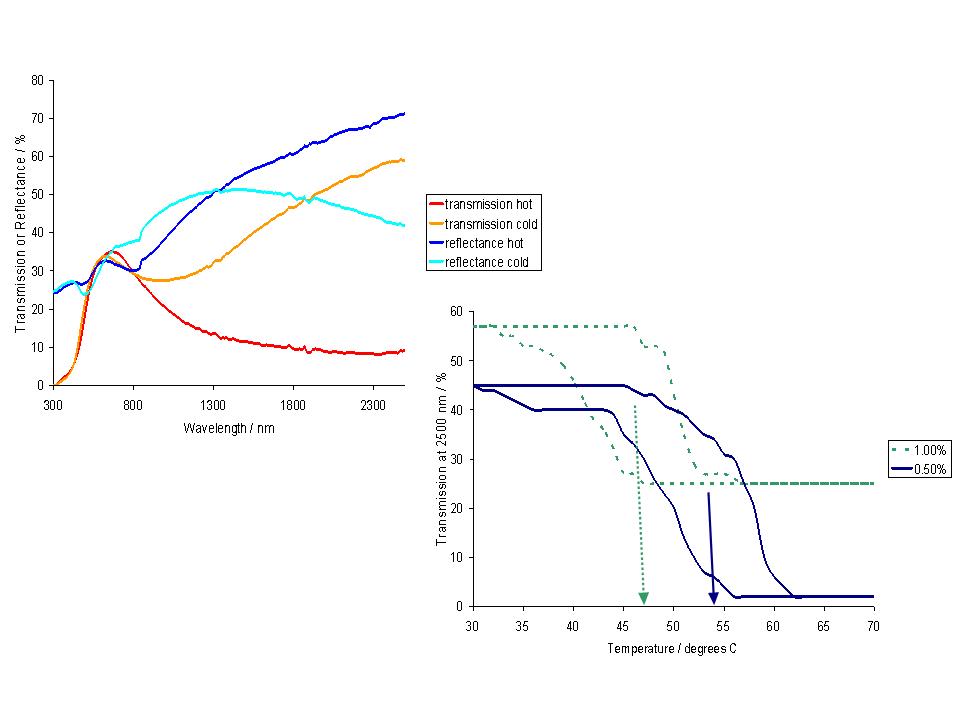
-) How to vary transmittance and reflectance of a thermochromic glass coated by vanadium dioxide?
To answer this question I use material from
Russell Binions's site, who gaves me permission to use it days ago.
On the left we see the trends of the transmittance and reflectance at different temperatures:
-) Yellow pattern: transmission BELOW the critical temperature;
-) Red pattern: transmission ABOVE the critical temperature;
-) Light blue pattern: reflection BELOW the critical temperature;
-) Blue pattern: reflection ABOVE the critical temperature.
Note how in an autonomous way the transmittance is reduced strongly in the infrared range, while the reflectance on the contrary increases.
Now we can understand the fundamental effect of TC glass on energy savings.
In addition we have said in a
previous post :
""VO2 has a reddish color and it exhibits a transition from semiconductor to metal at the critical temperature Tc = 68 ° C with a change of its crystal structure. The value of the transition temperature isn't fixed, being able to change by using dopants (such as molybdenum or tungsten), depending on the environmental temperature that has to respond. ""
Today we see graphically what has been said.
In the second half of the previous picture we can see a hysteresis behavior in response to the variation of temperature at a wavelength λ = 2500 nm, between the heating and cooling of the glass. The critical temperature Tc is defined as the center of that cycle.
By doping the film with tungsten we see as the temperature drops considerably.
But these issues will be considered and analyzed in the future.