Tuesday, 12 June 2012

low-e and trasmittance

In this post I write about the low-e glass mentioned in the post glass kind. About this topic there is a very interesting article on greenbuildingadvisor.com:
""[..] During the 1980s, glazing manufacturers perfected spectrally selective coatings that made it possible to produce low-solar-gain insulated glazing. During the 1990s, as builders in hot climates learned how these coatings reduced cooling loads, low-solar-gain glazing took an increasing share of the U.S. market.

Most builders prefer to order just one type of glazing. Window manufacturers share the same interest, since they prefer to promote a limited number of glazing options. As a result, low-e insulated glazing with a low SHGC is fast becoming the industry norm, from the Canadian border to the Gulf of Mexico.""
As it is already known, the effects of this coating is to decrease the factor U of the glass, and therefore the transfer of heat.

They can be applied in two modes: one is called in line -CVD- and takes place during the creation of the device. The result is called hard coat: it is very durable and can be positioned externally in contact with the weather (though almost never happens). The second way of coating is done in a separate phase of the production of the glass (off-line)-MSVD-. The result, said soft coat, is much more vulnerable than the previous, and it can deteriorate even in contact with air. So this is usually placed between two glass panes. This method is much more flexible, and gives the possibility to obtain more products aiming at ​​the ideal glas.

Problem: the SHGC. Knowing that a window has a layer of low-e tells us nothing about the solar factor, because it is a different matter than the factor U (low-e layer acts with longer wavelengths). For this, we have an other factor called "Light to Solar Gain" (LSG), obtained from the relationship between light transmittance and solar factor. An higher value means that the glass lets through the visible but not infrared. If this value is at least 1.25 the device is called "spectrally selective glass" [1].
Question: It is always better than a low solar factor? Or in other words, it's always better a soft coat or an hard? The answer is "no, not always." A selective glass is ideally best, but everything depends on climate. From the article we read:
 ""A window can have low-and low SHGC and represent a good opportunity for a home in Florida, or a high SHGC and work for a home in Minnesota.""

 From the article, however we understand how the thing isn't acknowledged by some manufacturers or sales agents.

Now we see transmittance graphs of some low-e glasses produced by the same company.
Low-e with hard coat


Low-e with soft coat

Low-e selective with soft coat

Comparison

blu line =  Low-e with hard coat
red line = Low-e with soft coat
yellow line = selective Low-e


With soft coat the transmittance is almost exclusively within the range of the visible.

Wednesday, 6 June 2012

Great news!

Today I post a message on personal pages of R. Binions:
http://webspace.qmul.ac.uk/rbinions/

"" 19/04/2012 Marking season is well and truly Underway and i have been going through no fewer than 14 project reports! A serious activity. Aside form that i sono stati writing papers and blackberries yet to have submitted a couple. Hopefully I'll know here, my good news soon about Them. Some of my work on thermochromic glazing has-been recieving some attention on blogs - in particolare Marco Berti's "Building The Chameleon" - Have a look at the English site here. '"
This will mean that I have to upgrade more often the site http://chameleonbuilding.blogspot.it/!

Thanks for your job, Russel !!

Tuesday, 17 April 2012

Thermochromic glass (I)

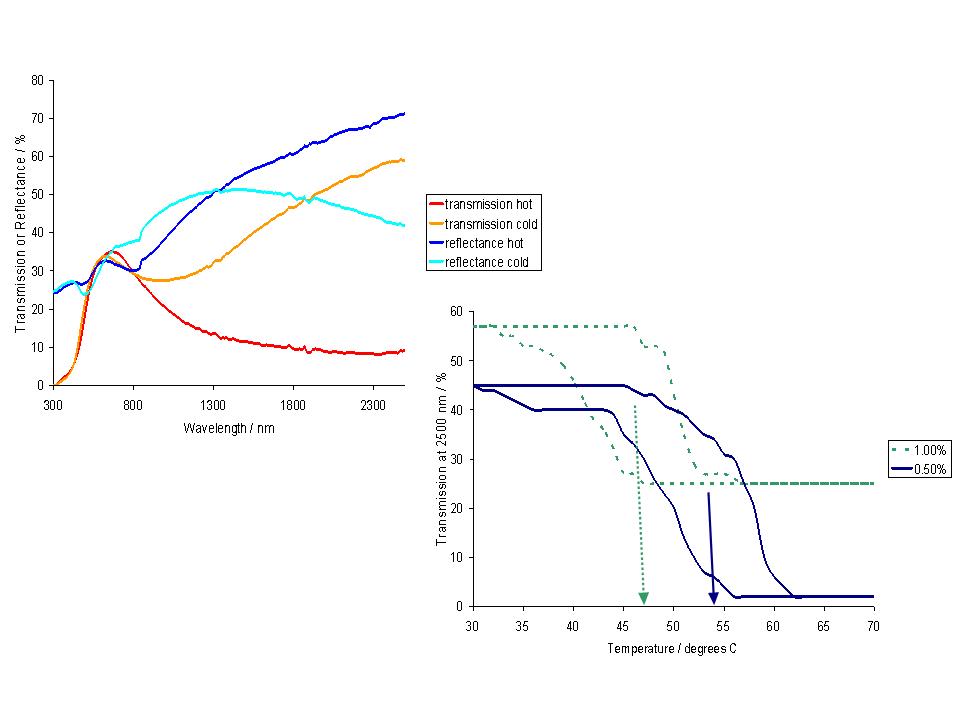
-) How to vary transmittance and reflectance of a thermochromic glass coated by vanadium dioxide?

To answer this question I use material from Russell Binions's site, who gaves me permission to use it days ago.
On the left we see the trends of the transmittance and reflectance at different temperatures:
-) Yellow pattern: transmission BELOW the critical temperature;
-) Red pattern: transmission ABOVE the critical temperature;
-) Light blue pattern: reflection BELOW the critical temperature;
-) Blue pattern: reflection ABOVE the critical temperature.

Note how in an autonomous way the transmittance is reduced strongly in the infrared range, while the reflectance on the contrary increases.
Now we can understand the fundamental effect of TC glass on energy savings.
 In addition we have said in a previous post :
""VO2 has a reddish color and it exhibits a transition from semiconductor to metal at the critical temperature Tc = 68 ° C with a change of its crystal structure. The value of the transition temperature isn't fixed, being able to change  by using dopants (such as molybdenum or tungsten), depending on the environmental temperature that  has to  respond. ""
Today we see graphically what has been said.
In the second half of the previous picture we can see a hysteresis behavior in response to the variation of temperature at a wavelength λ = 2500 nm, between the heating and cooling of the glass.  The critical temperature Tc is defined as the center of that cycle.
By doping the film with tungsten we see as the temperature drops considerably.

But these issues will be considered and analyzed in the future.

Tuesday, 27 March 2012

hard coat vs soft coat

Today i will talk again about low-e layers.

Where put we this films?

As we already said, it depends on the type: hard or soft.
As first we will define the surfaces which we will refer to.
The part of the double glass windows toward the outside is called Surface #1 and #2 #3 #4 follow, with #4 as the one facing the inside of the building.
Obviously if it is triple glass we have #5 and #6

We begin defining invernal condition:

Using as coating:  
Cardinal LoE 366 : low-e soft coat 4.8 mm
Pilkington Energy AdvantageTM : low-e hard coat 4.7 mm
then:
Pilkington Optifloat Clear : clear glass 4.7 mm
Internal chamber 12 mm with a mix of Air (10%) and Argon (90%)

Analizing U in invernal regime the singles surfaces temperatures are:


We notice that with the external hard coat we have not substantial improvements but we obtain a lower value of U with an internal coating, and so with the temperature.


The soft coat do not influence U and the temperatures, which are definitively higher than the other cases. But soft coat will influence the tripler glass behaviour.

Hybrid solution with soft and hard coats:


From this data we conclude that the hybrid solution soft#2 / hard#4 seems to be the more interesting, and so the Dual Low-E of Pilkington has been developed. But even this has some weaknesses.
Which ones in the next post.

Tuesday, 20 March 2012

Thermochromic glass

We return to the thermochromic glazing:
-)How they work?

Surely the most important principle is the use of vanadium, a mineral discovered by the mineralogist Andres Manuel del Rio in Mexico City in 1801, and having China, Finland, South Africa and the United States as largest producers.

His dioxide, VO2, has a reddish color and is a material that exhibits a transition from semiconductor to metal at the critical temperature Tc = 68°C, with a change in its crystal structure.
In fact the value of the transition temperature is not fixed and we are able to change it with the use of dopants (such as molybdenum or tungsten) depending on the required application and the environmental temperature to which will respond to. From the moment Granqvist proposed the film of VO2 like innovative coating for "smart windows", there have been many experiments to analyze the various aspects associated with it, using the different methods of deposition such as sputtering, CVD, sol-gel. Results have been achieved and analyzed for the various different aspects.

Monday, 5 March 2012

Smart window della Samsung

Strolling  around the net, looking for fresh news on "smart windows" for energy saving, i found this post with a video, and i found it curious:
""Trust Samsung to come up with an innovation that completely shocks the world, and yet manages to stay green. Unveiled at CES 2012, the Samsung Smart Window could be the next to-die-for addition to your home. Essentially a large transparent touch screen that doubles up as a full-fledged window, this is the type you wouldn’t want people throwing rocks at to grab your attention when your parents are asleep and your phone line’s dead. Enabling you to check you social network accounts, watch movies, book flight tickets, keep up with   presentations and a lot more, this fabulously intelligent window uses solar energy to charge up, keeping your energy footprint minimal. A brilliant innovation that the world is bound to welcome home.""

Here is called smart a touchscreen working as a windows. I found this invention interesting but i hope they wont use this concept as "smart windows". Luckily i found a polemic article that criticize this definition:
""[..] The device is really a transparent touch screen LCD that can be fitted to any window, so long as it’s no longer than some 46 inches. Resolution is 1366 x 768 pixels, reportedly. During the day, illumination is provided from outside. At night, built-in lights kick in. [..] Samsung has indicated an intention to put the thing out by the end of the year. No word on price yet. Aren’t there privacy concerns, as windows become devices for browsing, tweeting, and watching TV? Samsung assures that your neighbors won’t be able to see what you’re doing; the glass works like a one-way mirror when viewed from the outside. Here’s the main problem with Samsung’s “smart window” concept, though: touch screens, as Steve Jobs said, “don’t want to be vertical”—holding your arm out to fiddle with them just plain doesn’t feel nice, as I addressed in a post earlier in the week. Does that mean the only suitable market for a Samsung smart window is a glass-bottom boat? ""

Friday, 2 March 2012

Inverter for photovoltaic panels

What are inverters for photovoltaic panels? 
To answer at this question, I use a part of the site http://www.bcp-energia.it/:

    
"" The
inverter is an electronic device for converting direct current generated by solar cells into alternating one. It's connected to the electricity grid to power the main uses of your home. Since the control unit is powered by the photovoltaic modules, the inverter is switched off completely during the night, and so it doesn't consume energy.

    
These devices extend basic possibilities of
generic inverters with other, more advanced, through the use of particular control system to extract maximum power from solar panels. This function is called MPPT, an acronym for Maximum Power Point Tracker.

    
The photovoltaic modules in fact, have a characteristic curve V / I; there's an optimum working point said maximum power point, where it's possible to extract all the available power. This point of the characteristic
curve varies continuously as a function of solar radiation striking the cell surface. It's evident that with an inverter "freezed" at this point,we can always have the maximum power available in any condition. ""

 
For example :


"" There are several techniques for creating the MPPT function, with differences in dynamic performance and accuracy. Although the MPPT accuracy is extremely important, the settling time is, in some cases, even more. While all inverter manufacturers are able to obtain accurate on MPPT (typically between 99 to 99.6% of the maximum available), only few are able to combine speed with accuracy.

   On days with variable cloudiness we have the greatest change of solar power.
It's very common to detect variations of 100W / m² to 1000-1200W /
in less than 2 seconds. Under these conditions, which are very frequent, an inverter with settling times less than 5 seconds can produce up to 15% -20% of energy more than a slower one. [..] ""
To finish the post, I report the news of a product read some days ago:

""[..] Siemens Industry Inc. further strengthens its portfolio of solar inverters with the introduction of its new Sinvert PVM UL inverter, designed for peak efficiency and maximum plant yields to convert solar energy into grid-compliant AC voltage for infeed into conventional power supply networks. The Sinvert PVM UL inverters are available in the range from 12kW to 24kW for small to medium sized plants in the commercial market, and are capable of delivering over 98% peak efficiency. [..] ""
http://www.bcp-energia.it/ :
http://www.onlinetes.com/renewable-solar-energy-Siemens-022912.aspx